Bakewell Quakers
Simple • Radical • Spiritual
George Fox and Quaker Testimonies
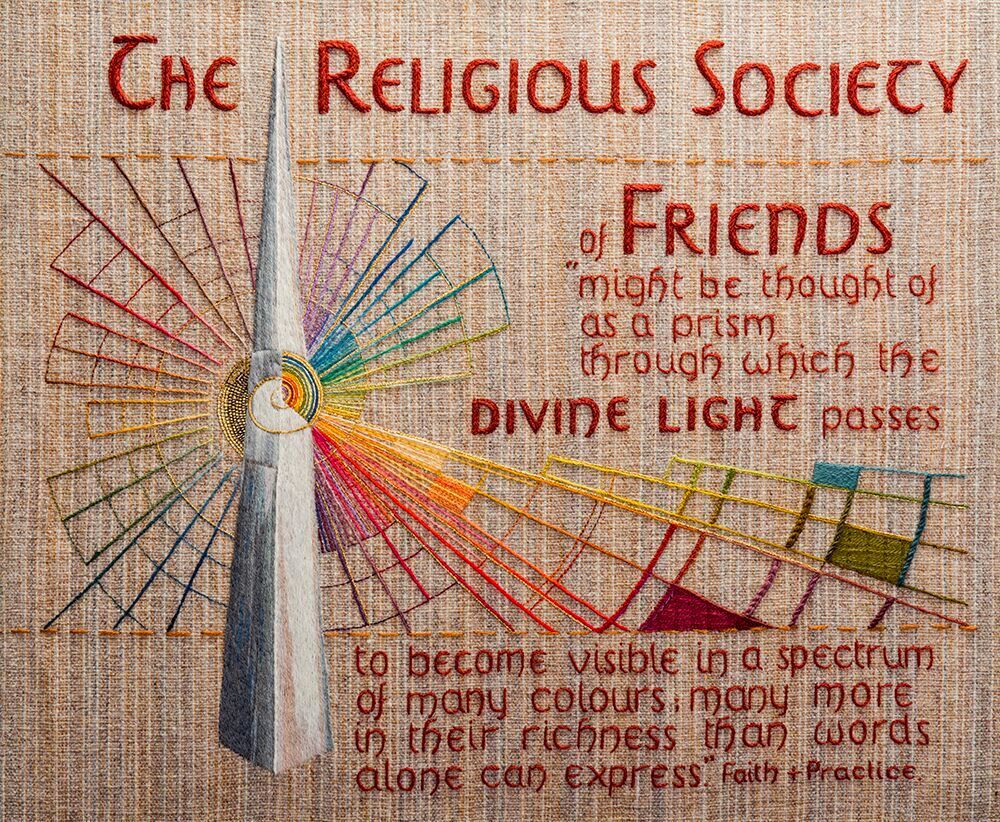
The Quaker Tapestry reproduced here consists of more than 40 embroidered panels illustrating the history of Quakerism from the 17th century to the present day. Made by over 4,000 men, women and children from 15 countries over 15 years, the tapestry has a permanent home at the Friends Meeting House at Kendal, Cumbria. For more information and to book a viewing, please browse their website here.
GEORGE FOX – Early Life
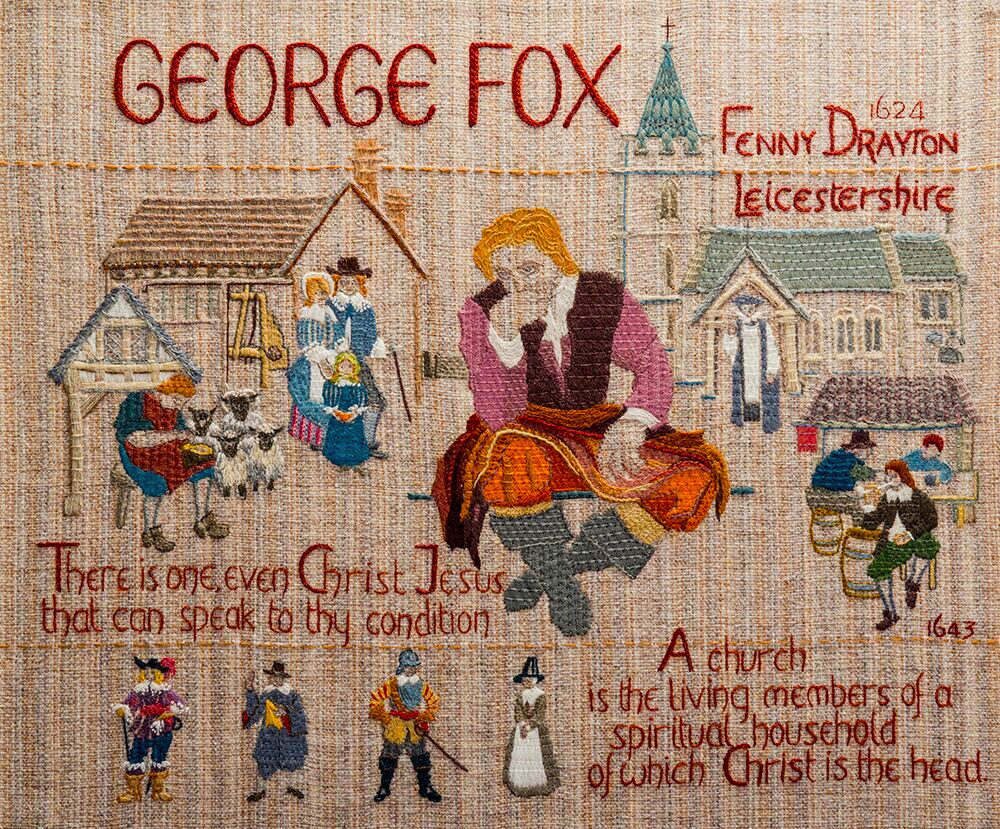
George Fox was one of the founders of Quakerism. While he was inspired and supported by many others it is unlikely that the Children of the Light, an early name for the Religious Society of Friends, would have evolved without the vision, courage and leadership of George Fox. This year celebrates the 400th anniversary of George Fox’s birth.
George Fox was born in 1624, at Drayton-in-the-Clay, Leicestershire. His father Christopher Fox, a weaver, was an ‘honest man’, and according to neighbours a ‘Righteous Christer.’ His mother Mary Lago was descended from ‘martyrs’ who had suffered under the brief restoration of Catholicism in 1553. George Fox had brothers and sisters but stood out as an inquisitive and challenging child.
The family were regular attenders at the parish church where Fox, even as a young child, was puzzled by the relationship between religious worship and daily life. He was particularly vexed by the hypocritical behaviour of some members of the congregation – pious Christians during the service yet ill-behaved and with no regard for Christian values outside the church.
By the age of eleven Fox had come to some definite conclusions: he must be honest in all things; he must never say one thing and mean another; and he must avoid greed in eating and drinking. These were conclusions which he would draw on later in developing a faith that became not just a theology but a guide to how we should live our lives.
His disenchantment, often accompanied by a deep depression, only increased as he consulted and often challenged church clergy who failed provide an answer for ‘his condition’- his inability to grasp his personal relationship with God. And so, despite having started a successful apprenticeship with a shoemaker, Fox adopted a peripatetic life in a search for this personal Truth.
The 17th century was a time of Civil Wars between parliament and the monarchy. At the same time the country was in religious ferment. In Europe, the 30 years’ war between Catholics and Protestants had just ended, a Presbyterian Church had been set up in Scotland, and in England a growing band of English Dissenters wished to break all ties between the church and state.
Fox was a natural networker and made contacts throughout his travels. He knew Cromwell, and members of the New Model Army, some of whom later joined the Children of the Light. And among the Dissenters he met the Seekers a “religious society” who held silent meetings, free of ritual, speaking when they felt moved by God, and which had no clergy or hierarchy. They were to have a significant influence on George Fox and the development of Quakerism.
And, in the darkness of his greatest despair, Fox finally heard a voice that told him ‘There is one, even Christ Jesus, that can speak to thy condition.’ There was no one on earth that could speak to his condition. It is only direct communication with God and Christ that can lead us to the Truth. Fox wrote that he learned this ‘experimentally’ through direct experience of God. It is the basis of the way Quakers worship today.
GEORGE FOX – The Birth of Quakerism and 1652 Country
Following George Fox’s Convincement in 1647 – his realisation that the only spiritual authority was the power and the love of God and that he had direct access to God – he felt empowered to start preaching in public. He first travelled around the Midlands, serving a couple of prison sentences for his preaching, and while in Yorkshire he decided to travel to the North West of England.
It was in early June 1652 while travelling with Richard Farnsworth that Fox spied Pendle Hill and immediately felt ‘moved of the Lord to go atop of it; and when I came atop of it I saw Lancashire sea;* and there atop of the hill I was moved to sound the day of the Lord; and the Lord let me see atop of the hill in what places he had a great people to be gathered.’ It was an extraordinary start to the journey that would prove to be an extraordinary month in this life.
It must have been a very clear view that day, Morecambe Bay surrounded by the Lakeland Fells and the Pennine Hills, the Lancashire Plain and the Yorkshire Dales. It was the land of the Westmorland Seekers, a network of Christians who could not find their spiritual home in the established churches. And it was land which George Fox would transform into the birthplace of Quakerism. Friends now refer to it as 1652 Country.
Fox travelled from Pendle to Wensleydale and Dentdale before arriving at Sedbergh at the time of the bustling Whitsuntide Fair. It was here that Fox first found his people. As was his custom, Fox chose to speak outside the parish church. Challenged as to why he was not in the church he responded, “The house is not the church but the people which Christ is head of.” A response that met with the approval of Francis Howgill, a leader of the Westmorland Seekers.
Fox was invited to speak the following Sunday on nearby Firbank Fell where Francis Howgill and his fellow leader John Audland were speaking. It was a gathering of over 1000 and there was some trepidation as to what Fox might say. The craggy fell provided a natural amphitheatre as Fox took his chance with a message they were eager to hear: that there were no barriers between man and God; that no human intermediary was necessary; that Christ was a living presence who would be their leader; and that the Bible was not the be all and end all of truth.
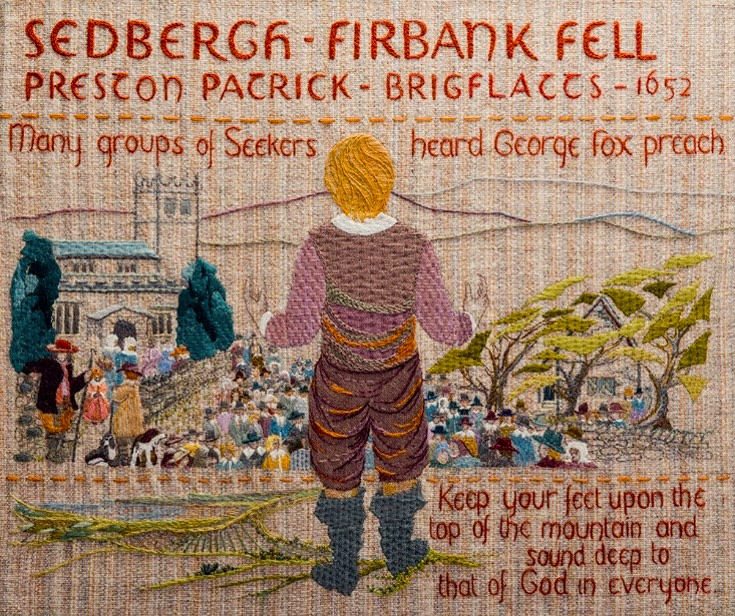
George Fox’s message reverberated far beyond the amphitheatre of Firbank Fell. It was the first important gathering of the Society of Friends. ‘The Kingdom of Heaven did gather us and catch us all, as in a net,’ Francis Howgill wrote as the Westmorland Seekers flocked to hear Fox on his journey though Preston Patrick, Kendal and the Lakeland Peninsulas. Many were convinced by Fox and joined the fledgling movement. And by the end of June Fox had reached Swarthmore
Swarthmore Hall was the home of Thomas and Margaret Fell. Thomas, Judge Fell, was away on business and Margaret was out when George Fox arrived at the hall, and it was left to the eldest children to greet him. The Fells were used to receiving visitors and although involved in their local church, they had been anticipating Fox’s arrival and made him welcome. Within days Fox converted them to his cause. Most of the family and many of the servants became Friends and although Judge Fell declined, he remained sympathetic to Fox, and the Fells offered him the use of Swarthmore, which became a centre from where Quakerism would grow.
- according to the journal quoted in Wikipedia, this is what GF wrote: “When I was come to the top, I saw the sea bordering upon Lancashire.”
I don’t know which is correct, but the Wiki version makes more sense
GEORGE FOX – After Swarthmore
By the time George Fox had finished his journey form Pendle to Swarthmore Quakerism had been born amongst the Seekers of Westmorland. Thomas and Margaret Fell’s offer of the use of Swarthmore Hall provided a centre from which the movement could grow. Judge Fell provided protection for early Friends while Margaret, with the support of her large family, provided administrative flair to match George Fox’s vision.
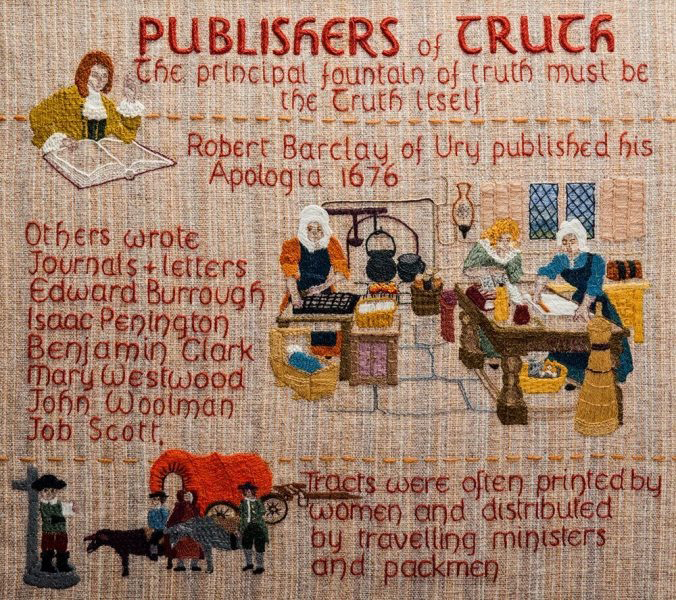
Fox was a natural organiser, so as more Friends arrived at Swarthmore, they were sent in teams of two, often young and old, men and women, to preach the Quaker message across Britain and Ireland. Often referred to as the Publishers of the Truth, the campaign was supported by hundreds of posters, leaflets and books printed secretly (and illegally) in Friends’ homes. Quickly Quaker communities started to emerge in towns and villages across the country.
But the growth of the Quaker movement with its radical religious and social agenda was not universally popular. The established church resented the attacks on its authority while landowners were suspicious of Quaker motives. George Fox was attacked and was frequently jailed. Even around Swarthmore, with Judge Fell away, he was beaten by a mob and whipped by the authorities. Many of the Publishers of the Truth also suffered and spent time in jail.
With the restoration of the monarchy in 1660 these spasmodic attacks became a systematic persecution of Quakers. George Fox and Margaret Fell responded by presenting Charles II with the first Quaker Peace Testimony, a commitment to non-violence. It had no effect and in 1662 Quaker worship was forbidden. During this period 15,000 Friends suffered legal sentences, usually for blasphemy or failing to make an oath of allegiance in court. Many Friends were jailed and over 450 died in prison. George Fox and Margaret Fell were frequently in jail.
Fearing for the future of Quakers, in 1666 Fox set up a structure of local weekly and regional monthly meetings, together with a national yearly meeting, which gave some protection to the movement. In 1675 following an investigation by two Friends, the Meeting for Sufferings was set up to support those affected by the persecution. This persecution continued in waves until religious dissenters were pardoned in the 1690s and finally ended in 1689 with the Act of Toleration.
George Fox married the widowed Margaret Fell in 1669. Although continuing to work together, they spent a long time apart. In 1671 Fox travelled to see Friends in the West Indies and America and in 1677 and 1684 he made similar visits to Holland. George Fox continued to work in London where Margaret Fell made visits from Swarthmore to see him, the last just before his death in 1691.
In 1647 George Fox had a vision that would transform our relationship with God. With the conversion of sympathetic Seekers who shared similar ideas, Fox went on to form what became the Religious Society of Friends. Despite fierce opposition from Church and State, Fox helped the Society to flourish in Britain and across the world. There are now 400,000 Friends in 87 countries. And the Society still reflects Fox’s radical, uncompromising agenda and the struggle for its early survival in its organisation and its Testimonies.
Fox received considerable support and could not have created the Quaker Movement alone. But it is unlikely that it could ever have happened without him.
Quaker testimonies
Following the example of George Fox and early Friends, Quakers continue to live and work today by the testimonies to simplicity, truth, equality and peace.
Simplicity: Quakers try to live simply. We focus on the things that really matter and that bring us closer to God. We focus on the people around us, the natural world and our experience of meeting for worship.
‘Try to live simply. A simple lifestyle freely chosen is a source of strength. Do not be persuaded into buying what you do not need or cannot afford. Do you keep yourself informed about the effects your style of living is having on the global economy and environment?’ (Advices and Queries 41)
Truth: we try to live according to the deepest truth we know. We connect most deeply to this in the stillness of worship. We try to always speak the truth and act with integrity. This includes when we are talking to people in positions of power.
Equality: Quakers believe everyone is equal. Each of us is “a child of God”. Nobody is more important than anyone else.
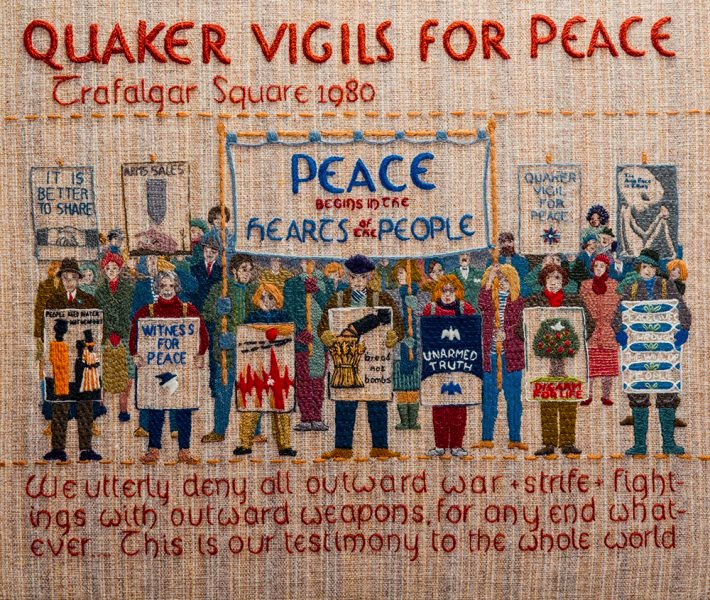
Peace: we are well known for our peace testimony. It comes from our belief that love is at the centre of existence and that all human life is of equal worth. Over many years Quakers have worked for peace, exploring and sharing creative nonviolent approaches to conflict and alternative approaches to violence.
‘We are called to live ‘in the virtue of that life and power that takes away the occasion of all wars. Do you faithfully maintain our testimony that war and the spirit of war are inconsistent with the spirit of Christ? Search out whatever in your own life may contain the seeds of war. Stand firm in our testimony, even when others commit or prepare to commit acts of violence, yet always remember that they too are children of God.’ (Advices and Queries 31)
In recent years, sustainability has taken its place alongside peace, truth, equality and simplicity to encapsulate Quaker values in the world.
Bakewell Quakers today
Quakerism is a radical church, born in radical times, and Quakers continue to live their faith in the world.
In the 17th century, early Quakers preached that each individual could experience inner light, or the voice of God, as part of a simple church which didn’t need a priest, or sacraments.
This shapes modern Quaker beliefs: that all humans have that of God within them; that all are equal and deserving of equal treatment and respect; that faith should be lived and acted out every day.
Drawing on these beliefs, Quakers continue to work for prison reform and against arms manufacturing. Quakers nationally have mediated in conflicts and were the first religious organisation in Britain to recognise same-sex marriage.
Quakers were involved in founding national charities to tackle serious issues of the day: Oxfam; Child Poverty Action Group; Greenpeace; Amnesty International; and Save the Children.
With radical change needed, Quakers find in their faith a spiritual home which sustains them in working for that change. In Bakewell, a Meeting for Worship is held each Sunday at 10.30 am at the Meeting House. The gathered silence and ministry offered by those present is the source of inspiration and the root of action in the world.
Quakers in Bakewell are active participants in the Bakewell Refugee and Asylum Seeker support network, offering hospitality days and advocating for a kinder asylum system in the UK. We hold peace vigils and work for climate justice,
A programme of events throughout the year offers opportunities for learning and discussion on topics as varied as slavery and reparations, finding hope in troubled times, and links between faith and professional life.
Visitors are always welcome!
The History of the Bakewell Quaker Meeting
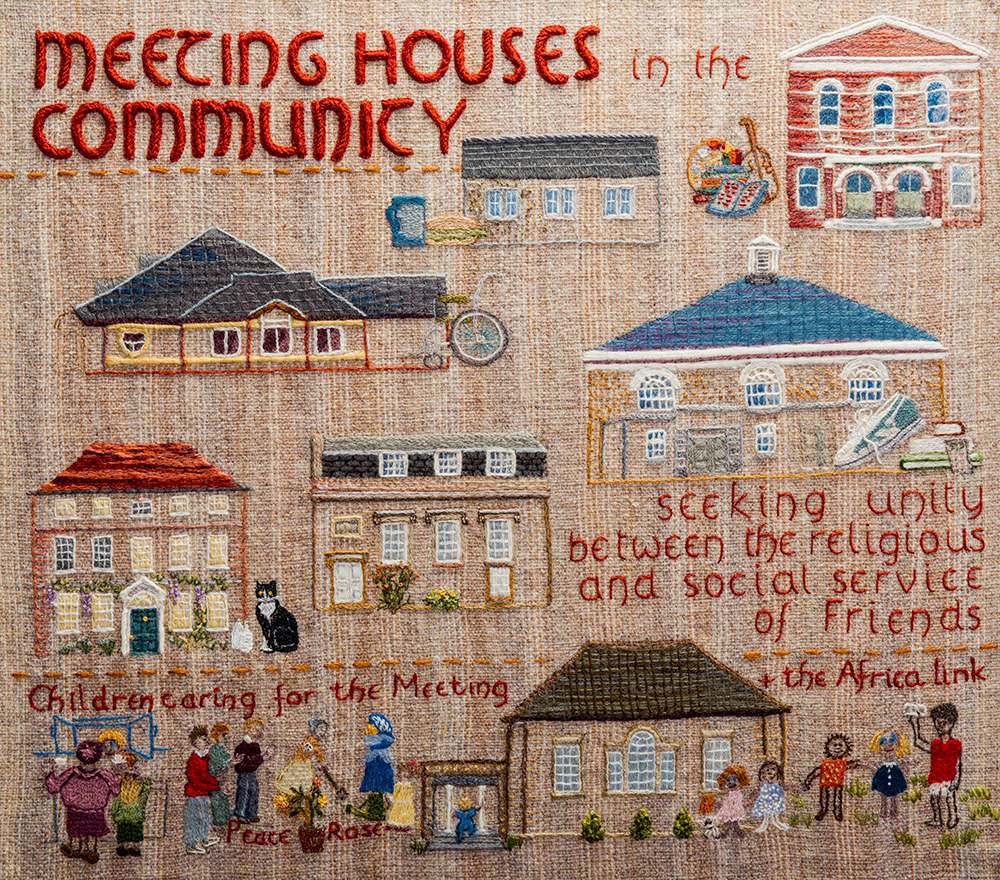
The Friends Meeting House was built in 1852, on land given by the Bowman family of Monyash, and possibly financed by the Alcard family. Friends had previously met at the Quaker Meeting House in Monyash, but numbers had grown to a sufficient level to support a new meeting in Bakewell. The first meeting was held on July 10th 1853, and meetings appear to have been well attended. The building was a single large hall, with a gallery at the north end, and a social room or possibly a women’s meeting room below it. There was a raised Elders bench at the south end.
However, the meeting dwindled and closed in 1886. During the first world war, the Meeting House was used to provide refreshment for wounded soldiers. Around 1916 the meeting was revived and the minute books start again from 1923. Attendance was low and fluctuated for many years (the Lean family doubled regular attendance when they joined in 1937) but was sustained by the Brayshaws.
In 1937 the building was leased to the Ministry of Works as an employment exchange, and from 1939 was used for recreation by prisoners of war, with Friends meeting in the pre-fab hut in the field behind.
After the war, Quakers took back possession of the Meeting House, and substantial repairs made good the damage sustained by its war use. At this time St John Ambulance took over the hut to the rear.
In 1954 the building was leased to Derbyshire County Council Local Education Authority for use as additional classroom space for the Methodist school. Outside school hours the building continued to be used by the few Friends in the Meeting at that time. Regular attendance was between one and three, and there was a notice welcoming visitors, and apologising if no Bakewell Friends were present. At times, the only Friend present was Joyce Pickard, who cycled up from Derby! However, Friends also planned to start a children’s meeting.
During the 1960s attendance increased steadily to a dozen, and in 1971 the building was renovated to provide internal toilets and a kitchen, and the old solid fuel boiler was replaced by gas. The first regular lettings started, with the newly formed Photographic club.
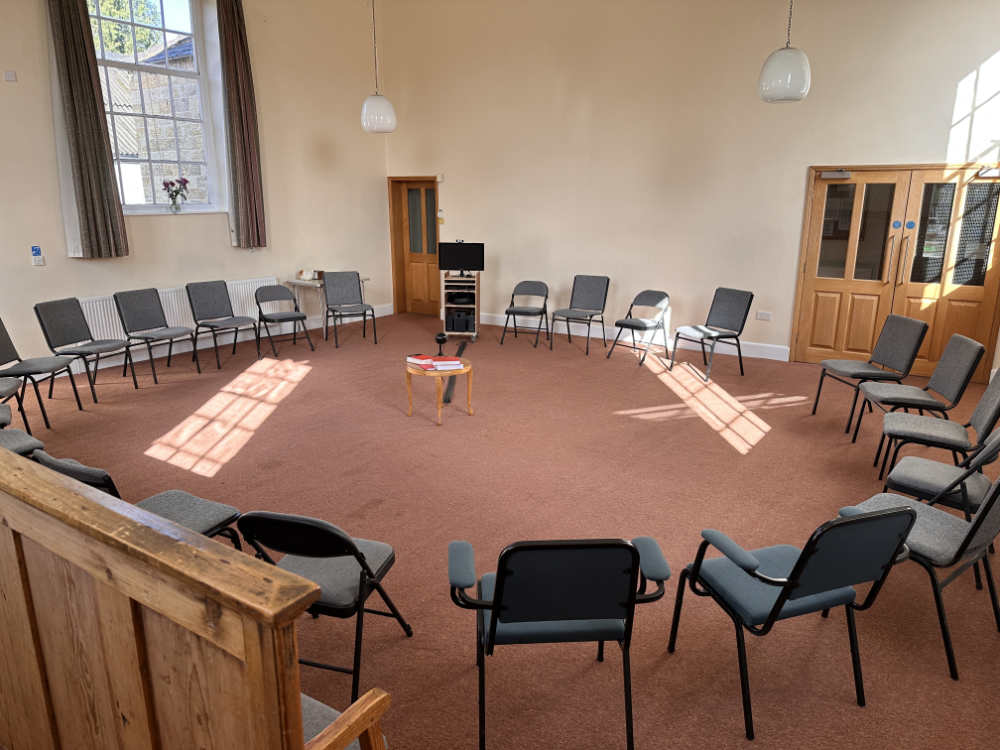
The mid 1980s saw increasing numbers attending, and a regular children’s class. In 2001, pressure of steadily increasing numbers of both adults and children, along with the requirements of the Disability Discrimination Act, prompted planning for a major renovation, which was finally undertaken in 2006-2007, replacing old extensions on the west side, and adding a new first floor to the northern half of the building
Since 2007 the Meeting has continued to thrive. The meeting house is now used regularly by 15 local organisations throughout the week and represents both a spiritual home for Quakers in Bakewell and beyond and a valued community resource.
Quaker Burial Grounds
In the very early days Quakers were buried in their own gardens or orchards, or in fields and premises belonging to other Friends. They had no grave-yards of their own. They refused to be buried in Church cemeteries as this would involve recognising the role of the priest and the distinction of consecrated ground – both concepts at odds with their view of a simpler church.
So as Meetings were established and land was purchased, they also acquired land for burial grounds.
Records of interment in the burial ground adjacent to the Meeting House in Bakewell start in 1856. The burial ground is still in use today for the ashes of Friends who have indicated that it is their wish to be buried here.
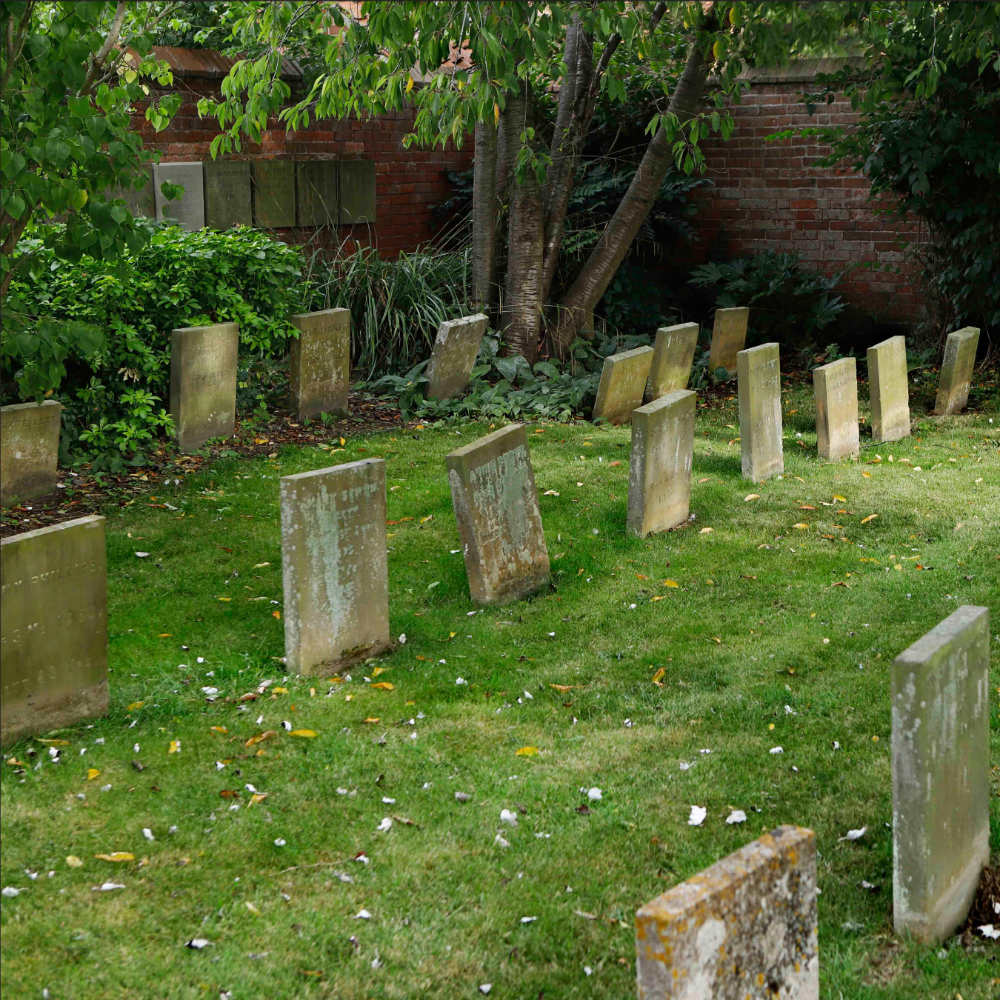
In Bakewell, the stones, which had been upright, were laid flat in 1946. In other grounds, such as this one in Brant Broughton, the stones remain upright.
Quakers felt that the use of gravestones and their inscriptions was not the proper manner of honouring the dead, as ‘they convey no inspiration and no record of the power and divine grace in human life.’ As a result, many of the graves of early Friends have no stones. Where gravestones are used, they are plain and usually carry nothing more than the name and the date of birth and death of the relevant Friend.
All aspects of this approach reflect the testimonies to equality and simplicity. There are no public displays of wealth or position: stones are kept small and of a uniform shape and size.
All are treated equally in death, as Quakers believe they should be in life.
Why people come to Bakewell Quaker Meeting
‘Coming to Meeting helps me make sense of life in general and my life in particular. It stabilises me, guides me in the right direction, and it gives me strength for the coming week.’
‘I value the strong, vivid and diverse characters who comprise the community.’
‘Last Sunday the Quaker community created the space for me to experience a very special hour.’
‘We are an enabling community.’
‘It’s the largest community I belong to and the only one where my children are welcome.’
‘Being a Quaker is important to me and meeting for the worship is at the core of being a Quaker. It gives me a chance to step aside from the rush of everyday life and reset my moral compass.’
‘My Quaker community means people who think and talk about what matters.’
‘Quakers seek a faith for living in this world. In worship we gather as fellow seekers to guide and encourage each other.’
‘Everyone’s contribution is valued.’
‘I like being part of a community where responsibility is shared.’
‘I can follow my own path without being alone.’
‘After seeking for over 50 years, I found the faith I was hoping for.’
‘The practice of the presence of God.’
‘As I open my heart to the possibility of God, I experience renewal; transformation. I sense the Spirit within me, and between us all. This doesn’t happen all the time. My mind wanders. I get distracted. But I am continually surprised that, even when I am feeling grumpy and out of sorts, I am called back to life again.’